Showing posts with label Milk Paint. Show all posts
Sunday, February 23, 2014
A Teasure Box for Clara
So I thought I'd take a short break from posting...and just nine months later I'm back!
Funny how life is sometimes...
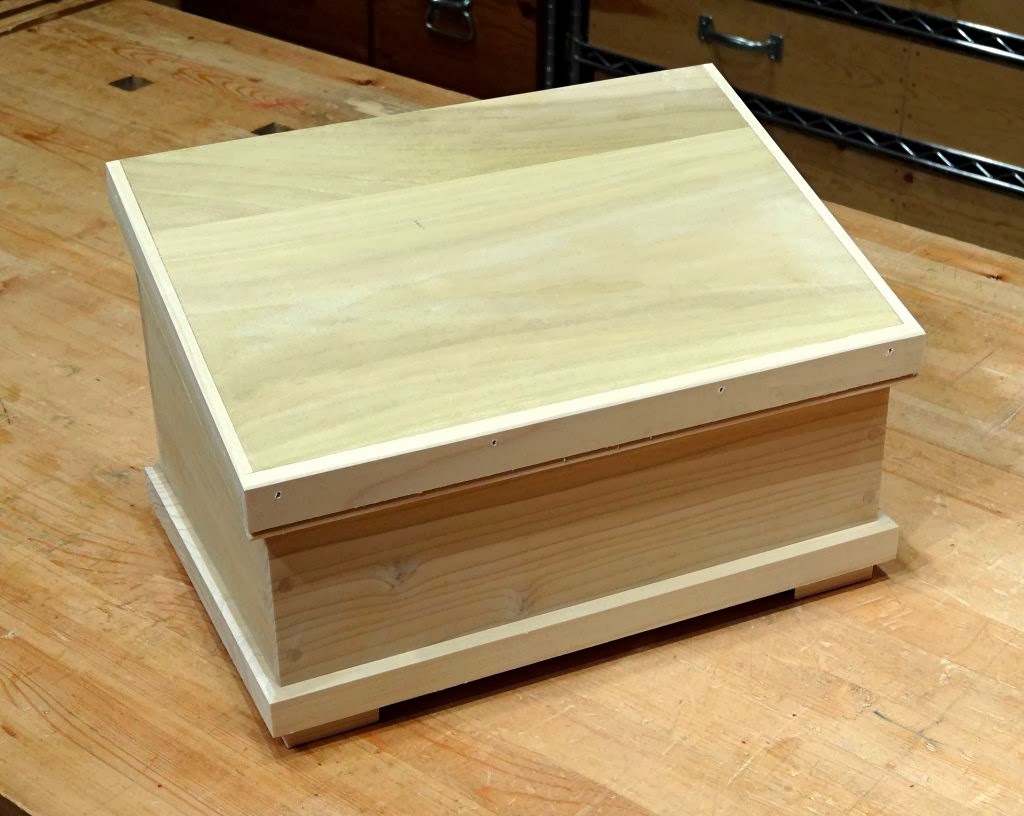
Anyway, here's something that was created during that time - a treasure box for my daughter's birthday. I used poplar; I can't remember why, but it was nice to work with.
Clara told me it had to be "red, with purple corners". I mixed up some milk paint, and interpreted those instructions loosely...
...but she didn't care! Joy!
And in use.
Of course, now the boy wants one too...
Monday, April 15, 2013
One Hour Stool Part II
So it was time to paint the "One Hour Stool". I had already decided to paint it blue, but just to be sure I brought out the milk paint sticks. Yup, it still wanted to be blue.
I broke out the Real Milk Paint and mixed up a batch of sky blue. I wanted the paint to be somewhat transparent, so I adjusted the proportions to make it more of a wash.
After letting it sit for a bit, I painted up some scraps - Hey, those look like busted up legs from a small stool! Huh, wonder how that happened? Anyway, after they dried, I tested some various oil/wax combinations to see how they would change the appearance.
On the left, is my own beeswax/mineral oil mix. In the center, is Tried & True Varnish Oil. On the right, is Dark Tung Oil. I decided on one coat of the T&T Varnish Oil, and one coat of my own mix.
On to the stool.
First the paint.
Then the oil.
And it's done! I didn't keep track of time during this stage of the stool build. I'd have to estimate that the painting and oiling took about 45 minutes total shop time.
So I guess that would make this one hour stool a two hour stool...
Monday, August 29, 2011
Shaker Inspired Medicine Cabinet - Part III
So this little improvised project was coming along nicely, and it was time for one final push to complete it.
When I first started this project, I couldn't really see how it would come out. I had only some misty, vague, ideas swirling around. I was just going to say "swirling around in my mind", but that would put too much emphasis on thinking. It was more of an exercise in trust or faith that this thing would take shape. I could "feel" it would be Shakerish, but I didn't really have any details, not at first, they just sort of appeared on their own as I worked with my hands. I'm not sure if any of this makes sense, but that's the best I can explain it right now.
So anyway, at some point, I started to realize that it would have a top cap - nothing fancy, just an overhanging top. For a while there was also a bottom, or base, but that faded away, never to return.
To make the top, I cut a piece of stock to overhang the case on the front and sides. Then I set the case on it upside down and traced around it with a pencil. This gave me the reference marks to bevel the underside of the overhang.
The beveling was accomplished with a bench plane while the stock was held with the holdfasts. This piece was too small for both holdfasts to reach, and rather than boring another hole, I rigged the setup you can see here. The work piece was held by only one holdfast, but couldn't rotate because it was jammed against a piece of scrap held by the second holdfast; it worked great.
I worked the end bevels first, so any splintering or spelching at the front edge would be planed away by the front bevel.
To glue the top to the case, I clamped them together, upside down, on the bench. This is a perfect example of why I am frequently glad I don't have a front apron on my bench.
To hang the cabinet on the wall, I chose keyhole style hangers. As I planned on using Lee Valley "best-ever picture screws" with these, I needed to bore clearance holes in the case. I also decided to mortise the hangers into the case so that it would fit snug to the wall, without any gap.
Here's a shot of the work in progress:
For the back, I used the 3/8" cedar T&G paneling scraps. It was simple enough to cut off the excess from the outside edges with a knife and plane them down for a tight fit (humidity is about as high as it is going to get right now, so I figured I didn't need to leave room for expansion; I just had to think about contraction).
The back paneling was nailed on with brads. The shelf was sitting in place to check that it didn't interfere with the back. If the shelf had been a permanent, fixed shelf, I would have nailed the paneling to it as well.
And here's the cabinet with all assembly completed, awaiting the milk paint.
I had a little trouble getting the color I wanted, and ended up mixing two reds together to find what I was looking for - red, but not too red. Also, this is the first appearance of the toggle lock for the door. It's notched to fit over the knob. Why? I don't know - it's just the way it wanted to be...
And two shots of the cabinet after hitting it with oil. I love the way this works with the paint.
And finally, two shots of the finished medicine cabinet hanging in its new home.
I have to say, in the end it came out exactly how I felt it would, but not exactly how I thought it would. It fits my definition of "Shakerish" and makes me happy on a daily basis. Cool.
Up next, a short post on the tool kit used for this project.
Tuesday, July 28, 2009
Milk Paint Samples
I've talked before about how much I enjoy using milk paint; it's just fantastic. Very easy to use, non-toxic, lasts about forever in its powdered state, versatile (translucent wash/stain or completely opaque)and incredibly durable. What's more, it has the look of old fashioned paint because, well, it is old fashioned paint. What's not to love?
You can use the milk paint by itself for a dull (and sometimes slightly chalky) look that is quite nice, but I really like it with a coat of oil, or oil and wax over the paint. This evens out the color a bit, and produces a wonderful satin sheen. There is only one down side - it also changes the color; sometimes a little, sometimes a lot. Not a big deal, unless you are going for a specific look, then it's nice to know what will happen ahead of time.
In the past my solution to this problem has been to mix up some paint, paint a few sample boards, then oil it when it's dry. Not ideal. First, it wastes some paint. Second, the milk paint and oil continue to "age" for quite a while - so the samples are not perfect.
My new solution was so obvious it's silly. I ordered two sets of "color sticks" from my milk paint provider of choice: The Real Milk Paint Co. Okay, really I ordered four sets, two each of their "traditional" and "historical" sets - but I just combine them. One set I left plain, and one set I oiled. And "BAM!", instant samples of both oiled and non-oiled milk paint! I know, it's so simple...can't believe it took me years to figure this one out...Sheesh!*

Here they are matched up by color. The oiled set is on the bottom. You can see how some colors shift ever so slightly while others change dramatically. To keep them handy, I string them together on some twine and they hang in a corner of my shop:

Note: I've added a "milk paint" label to this post as well as some relevant previous posts. You can click on it in the "Post Categories" list if you want to read and see more about my experiences with milk paint.
*I almost didn't post this, because now that I thought of it, it seems SO obvious. But then I thought, "What the heck, maybe this will actually help someone..."
Sunday, April 12, 2009
Design Experiment - Small Improvised Box
After cleaning up the caulking irons, I just couldn't put them back in the ammo box they came in. I had a vague idea that an airtight box, while certainly keeping moist air out, would also trap moisture in with the irons and would probably not be the best home for them. That seems like a good, practical idea - but of course there was more to it. I just didn't like the ammo box - not for these irons. It didn't make me happy. This might sound familiar...
Anyway, I needed to design and build a box for the caulking irons and this seemed like a good excuse to try an experiment. I've noticed that many pieces built by old timers have a certain "funky" element to them. They don't seem to follow any "rules" of design, and they sometimes flat out break them. But they have character in spades and are wonderful, unique pieces. Often times it seems that there was a material influence on the final form. Maybe they used what was on hand - a thrifty use of offcuts. Sometimes they aren't successful - the piece feels heavy or clunky - but sometimes it is successful, and the piece has a wonderful, funky, organic, improvised quality (and I mean improvised in a good way - like a jazz solo - not like a shoddy cover up...).

For this project/experiment, I decided to restrict the materials I could use, design as I went, and see what happened to the final product. I could only use scrap, or left-over wood and hardware. This was going to be a quick box - no worries about perfect surfaces etc.
Here's what I ended up using:
Wood:
Some pine shelves I took out of a cheapo CD cabinet I resurrected from Salvation Army
A piece of mahogany left over from the wood stove fence project
A chunk of 1x2 that was formally a sticker for a wood pile
3" hunk of 3/8" dowel
1 bamboo skewer
Hardware/fasteners:
Cheapo piano hinge from aforementioned cheapo CD cabinet
Screws from the wheel of homeless fasteners
Nails - aluminum tacks! From - well, I don't know where these came from...

The tools to be stored set some dimensions and the material available set others. The caulking wheel was 16" long. I only had two pieces of the pine shelving longer than that. Since I needed the two sides and the top and bottom to be 16"+ I had to get four out of two. One piece I ripped down the middle. This became the two long sides of the box. To hold all the irons the box needed to be wider, so I resawed the second piece and ended up with two thin (approx. 5/16") pieces for the top and the bottom. The ends I made from one of the shorter shelf pieces.
My original idea was to use wooden pins as hinges, so I made two cleats for the top that would overlap the ends of the box and provide me with a location for the pins. After making those from part of the 1x2, I couldn't work out the details of the pins/hinges, so I scrapped that idea and cut a chunk of piano hinge. Then I found the tacks, and used those to fasten the hinge to the back and the top. The front edge of the lid looked funny, so I ripped a strip of mahogany and glued that across the front edge, overlapping the ends of the cleats. Better, but now the base looked odd. More ripping of mahogany strips and I attached a mitered base to the box. Not too bad, but the box still looked top heavy.

I ignored that "problem" and moved on to the handle. I did find an old metal handle, but attaching it to the thin top would have required adding a strip of wood under the lid. I avoided that by sawing and carving a wooden handle and screwing up through the lid into the handle. Not only did that solve the practical challenge of how to attach a handle, it somehow solved the top heavy aesthetic problem as well (at least to my eyes). Unintentionally, the handle came out with an "Asian" flavor, and paired with the top being wider than the base, it gave the whole box a quasi pagoda nature. Weird.

To keep the lid from just opening when I pick it up by the handle, I made two locking pins from the dowel and the bamboo skewer. Then, to avoid losing them, I made two holes in the top edges of the ends to hold the pins. This also has the bonus feature of propping the lid open so it is obvious that it is not locked.

Two coats of bright red milk paint pulled the whole thing together and hid the different woods used. I followed the paint with my own mixture of mineral oil and beeswax.

I think this experiment was successful. The box is functional and has a pleasing design in a funky, improvised, unique way that keeps drawing my attention back to it. Much more enjoyable than the ammo box.

Here's the tool kit for this project:

Friday, January 2, 2009
Shaker Cupboard Photo Essay - Part III
Playing with the mouldings for the cupboard - ovolo and cove.

Put together as a built-up profile.

Mock-up of crown moulding in place - I liked it, but it was to "colonial" for this cupboard.

A simpler crown moulding mock-up - better - but I would eventually remove the thumbnail top and just go with a simple cove moulding. This also shows a test of one hinge design - taped in place - I liked it, but in the end went with one that had removable pins - it was easier to work with.

Doors complete - final fitting with the planes.

Doors fit - the end is in sight!

Hinge work - and a new appreciation of the Stanley #95 butt gauge.

Close-up of chisel scoring of hinge mortise.

Finishing the mortise with a router plane.

Testing the fit.

Making pilot holes with awl - a sharpened finish nail chucked in old cobbler's awl - the twisting motion seperates the wood fibers - I have more control than with a drill.

Lower doors hung.

Upper doors hung and knobs installed - I turned the knobs on my spring pole (shock cord) lathe - definitely the craftsmanship of risk - I need WAY more practice, and I think I should have used air dried birch rather than kiln dried pine.

Detail of knobs - the conflicting grain patterns won't matter once the cupboard is painted.

Speaking of which... milk paint of course - Union Blue from The Real Milk Paint Co. The cove mouldings had also been added to the top and the step.

And it's done! "Make Way! Blow the trumpets!"
There are still a couple of tweaks needed. I don't like how bright the hinges are - one day I will dull them down a bit. And I might add a second coat of milk paint eventually, but that depends on how it ages... But for now we are very happy with it! And I am very glad to have it out of the shop and in the house! Finally!

A group shot of the tools used on this project. The two contraptions at the bottom are my shooting board and the main part of the treadle lathe (w/o treadle). Missing from photo: miter box.

Subscribe to:
Posts (Atom)